

You check your email at 8 PM. You answer a Slack message while eating dinner. You wake up thinking about the Monday morning meeting before your eyes are even fully open. This isn't just busy; it's a bleed-over of professional demands into personal time that leaves you exhausted and disconnected. The promise of work-life balance often feels like a myth because we treat work and life as two separate buckets that need equal water. But for most modern professionals, they are mixed together in a single, turbulent container.
Meditation is not a magic wand that deletes your workload. It is, however, a highly effective tool for managing the boundary between who you are at work and who you are at home. By training your attention, you gain the ability to choose where your focus goes, rather than having it hijacked by notifications, anxiety, or habit. Here is how meditation actually works to restore balance, why traditional advice fails, and how you can start today without adding more stress to your plate.
The Myth of Separation vs. The Reality of Integration
For decades, corporate wellness programs have suggested that work-life balance means strict separation. Close the laptop at 5 PM. Do not think about work on weekends. While this sounds ideal, it ignores the reality of remote work, global teams, and the always-on culture driven by smartphones. When you try to force a hard stop, you often experience "rebound anxiety"-the fear that something important will slip through the cracks if you aren't watching.
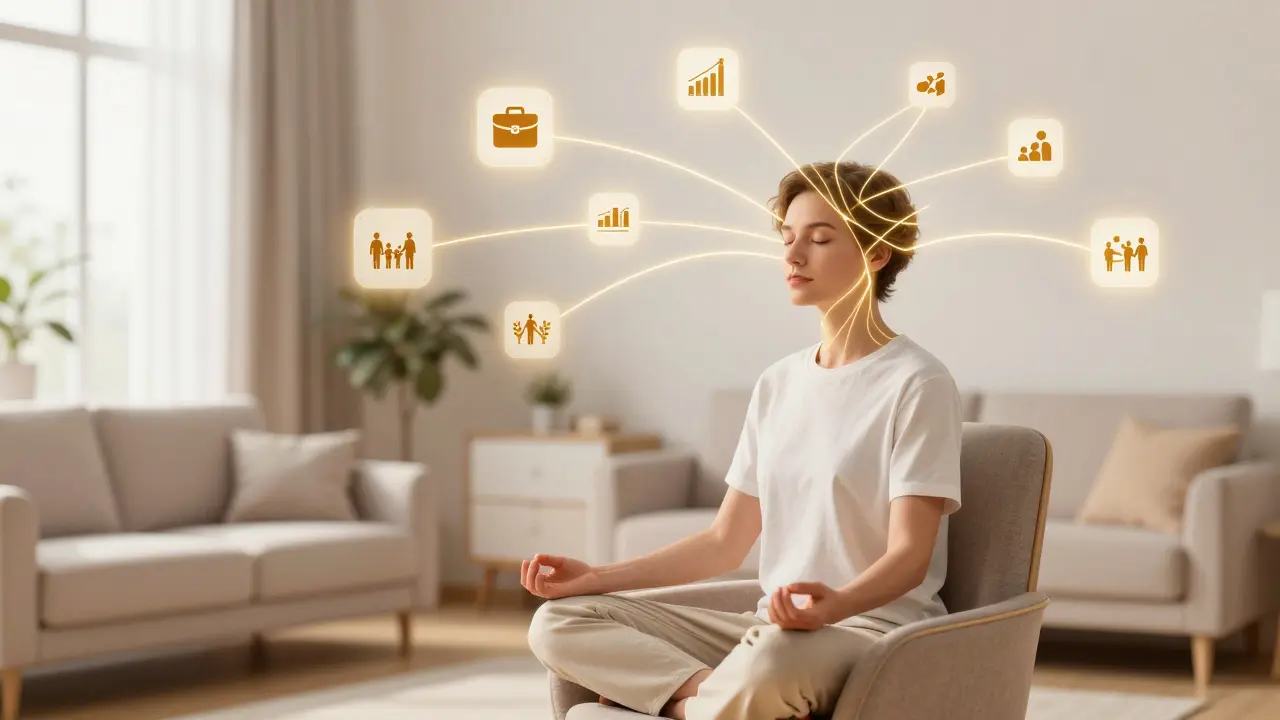
Meditation shifts the goal from separation keeping work and life in distinct boxes to integration managing energy and attention across all domains of life. Instead of asking, "Did I spend exactly 40 hours working and 40 hours living?" you ask, "Was I present when I was working, and was I present when I was with my family?"
This shift reduces guilt. If you are meditating during your lunch break, you are recharging so you can be fully engaged in the afternoon. If you take five minutes to breathe before a difficult conversation with your partner, you are bringing your best self to the relationship. Meditation makes you the manager of your attention, not a victim of your environment.
How Meditation Rewires Stress Response
To understand why meditation helps balance, you have to look at what happens in your brain when you are stressed. Chronic work pressure keeps your body in a state of low-grade fight-or-flight. Your sympathetic nervous system is stuck in the "on" position. This leads to decision fatigue, irritability, and an inability to relax even when you are off the clock.
Regular meditation practice strengthens the prefrontal cortex, the part of the brain responsible for executive function, decision-making, and emotional regulation. At the same time, it shrinks the amygdala, the brain's alarm bell. Studies using MRI scans have shown that after just eight weeks of mindfulness meditation, participants had less gray matter density in the amygdala and reported lower levels of stress.
In practical terms, this means:
- Faster recovery: You bounce back from a stressful client call quicker.
- Better boundaries: You recognize when you are overcommitting and say no without feeling guilty.
- Deeper rest: You fall asleep faster because your mind isn't racing through tomorrow's to-do list.
This biological change is the foundation of sustainable work-life balance. You cannot negotiate peace with a brain that is chemically primed for panic.
Practical Meditation Techniques for Busy Professionals
You do not need to sit on a cushion for an hour in silence. In fact, trying to carve out large blocks of time often adds to the stress. The key is consistency and brevity. Here are three techniques that fit into a chaotic schedule.
- The Micro-Break (1-3 Minutes): Set a timer for every 90 minutes of deep work. When it rings, close your eyes and focus only on your breath. Count inhales to four, exhales to six. This resets your nervous system and prevents burnout accumulation throughout the day.
- The Transition Ritual (5 Minutes): Use meditation to mark the end of your workday. Before you leave your desk or close your laptop, sit quietly for five minutes. Visualize placing your work tasks in a box and locking it. This creates a psychological boundary that signals to your brain: "Work is done. Personal time begins."
- Body Scan for Sleep (10 Minutes): Lie in bed and mentally scan your body from toes to head, releasing tension in each area. This combats the physical manifestation of stress and prepares you for restorative sleep, which is essential for cognitive performance the next day.
These practices are not about achieving a blank mind. They are about anchoring yourself in the present moment. Even if your mind wanders to emails, noticing that it wandered and gently bringing it back to your breath is the repetition that builds mental muscle.
Digital Tools vs. Traditional Practice
In 2026, we have more tools than ever to support meditation, but also more distractions. Apps like Headspace, Calm, and Insight Timer offer guided sessions that are excellent for beginners. They provide structure, progress tracking, and variety. However, relying solely on apps can sometimes create a dependency where you feel unable to meditate without a voice guiding you.
| Approach | Best For | Pros | Cons |
|---|---|---|---|
| Guided Apps | Beginners, structured learners | Easy to start, varied content, reminders | Subscription costs, screen dependency |
| Silent Sitting | Advanced practitioners, minimalists | Deepens focus, no cost, portable | Steep learning curve, requires discipline |
| Mindful Movement | Kinaesthetic learners, high-energy types | Combines exercise with mindfulness, reduces stiffness | Requires space/equipment, harder to multitask |
Consider hybridizing your approach. Use an app for the first month to build the habit, then gradually transition to silent sitting or mindful walking. Mindful movement, such as yoga or tai chi, is particularly effective for those who find stillness uncomfortable. It engages the body while calming the mind, offering a dual benefit for physical and mental health.

Integrating Mindfulness into Daily Routines
Meditation doesn't have to be a separate activity. It can be woven into existing habits. This is known as "informal practice." The goal is to bring awareness to automatic behaviors.
- Mindful Eating: Put your phone away during meals. Taste your food. Chew slowly. This breaks the cycle of distracted eating and gives your digestive system a break.
- Mindful Walking: When you walk to the bus stop or around the office, feel your feet hitting the ground. Notice the air on your skin. This turns a commute into a mini-meditation.
- Mindful Listening: In meetings or conversations, listen to understand, not to reply. Notice when your mind drifts to your response and bring it back to the speaker. This improves relationships and reduces misunderstandings.
By integrating mindfulness, you stop seeing meditation as another task on your to-do list. It becomes a lens through which you view your entire day. This pervasive awareness is what truly protects your work-life balance. You become aware of stress early, before it escalates, and you respond with intention rather than reaction.
Overcoming Common Obstacles
Most people quit meditation because they expect it to feel good immediately. It often doesn't. In the beginning, you might feel restless, bored, or even more anxious as suppressed thoughts surface. This is normal. It is similar to the soreness you feel after starting a new workout routine.
Another obstacle is the belief that you are "bad" at meditation. Meditation is not about stopping thoughts. It is about changing your relationship with them. If you notice your mind has wandered 100 times, and you bring it back 100 times, you have done 100 reps of mental training. That is success.
To overcome these hurdles:
- Start small: Two minutes is better than zero. Consistency beats duration.
- Be compassionate: Treat yourself with kindness when you miss a session. Guilt is counterproductive.
- Find community: Join a local group or online forum. Sharing experiences reduces isolation and increases accountability.
Remember, the goal is not perfection. The goal is presence. Every moment you are aware, you are reclaiming your time and energy from the autopilot mode that drains your work-life balance.
How long does it take for meditation to improve work-life balance?
Most people report noticeable improvements in stress levels and focus within 2 to 4 weeks of consistent daily practice. Structural changes in the brain, such as reduced amygdala reactivity, typically require 8 weeks or more. However, immediate benefits like calmness after a session can be felt instantly.
Can meditation replace therapy for work-related stress?
No. Meditation is a complementary tool, not a substitute for professional mental health care. If you are experiencing severe anxiety, depression, or burnout, consult a therapist or counselor. Meditation can enhance therapy by improving emotional regulation and self-awareness, but it should not be used as a standalone treatment for clinical conditions.
What is the best time of day to meditate for work-life balance?
The best time is whenever you can be consistent. Morning meditation sets a calm tone for the day, while evening meditation helps unwind and prepare for sleep. Many professionals find that a short mid-day break is most effective for resetting focus and preventing afternoon slumps.
Does meditation help with productivity?
Yes. By reducing distraction and improving focus, meditation can increase productivity. Studies show that mindfulness training enhances sustained attention and cognitive flexibility. This allows you to complete tasks more efficiently, potentially freeing up more time for personal activities.
Is there a difference between mindfulness and meditation?
Meditation is a formal practice, usually involving sitting quietly and focusing attention. Mindfulness is the quality of being aware and present in the moment. Meditation is one way to cultivate mindfulness, but mindfulness can also be practiced informally during daily activities like eating, walking, or listening.