
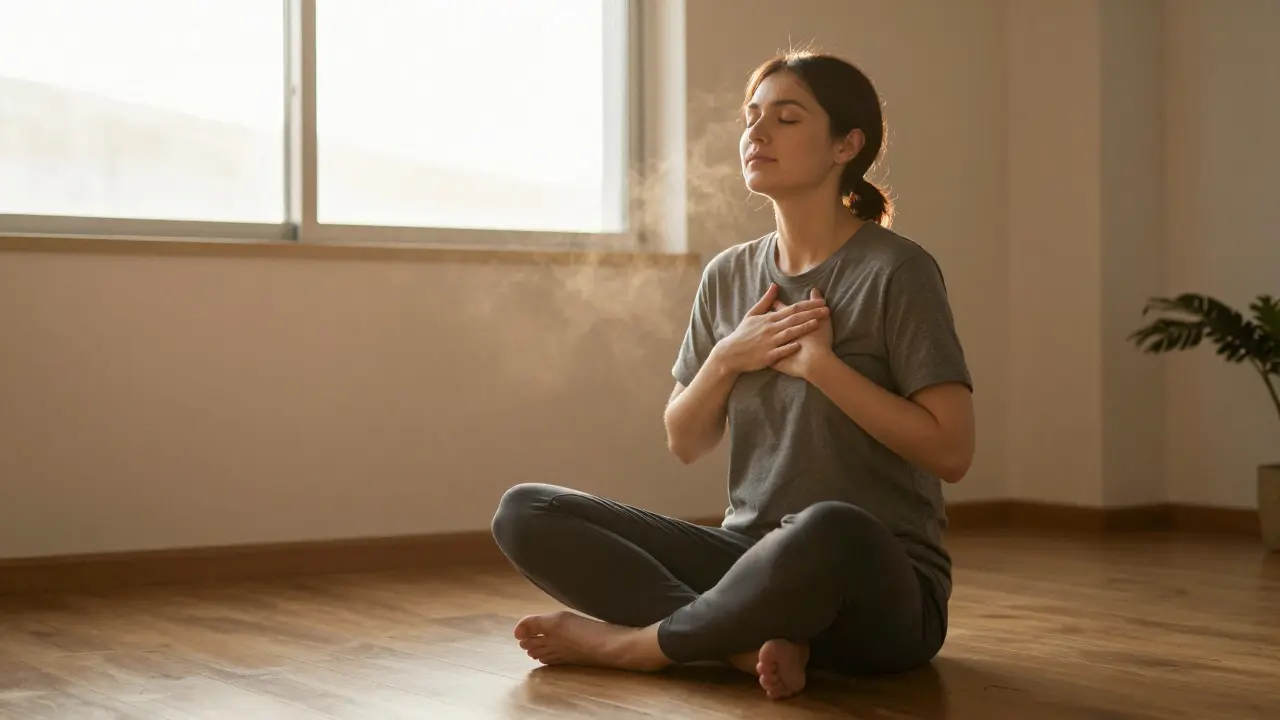
Stress isn’t just a feeling-it’s a physical reaction that can wreck your sleep, mess with your digestion, and leave you exhausted even after a full night’s rest. If you’ve ever felt your heart race after a work email, clenched your jaw during traffic, or lain awake replaying a conversation from three days ago, you know this isn’t just "being tense." It’s your body stuck in fight-or-flight mode. The good news? You don’t need a vacation, a spa day, or a magic pill to reset it. Simple, science-backed relaxation techniques can turn that chaos into calm-and they work in under five minutes.
Deep Breathing: Your Instant Reset Button
Most people breathe shallowly, using only the top of their lungs. That’s why you feel out of breath even when you’re not running. Deep breathing flips the script. It signals your nervous system: "Everything’s okay."
Try this: Sit or lie down. Place one hand on your belly, the other on your chest. Breathe in slowly through your nose for four counts, letting your belly rise like a balloon. Hold for two counts. Then exhale through your mouth for six counts, letting your belly fall. Repeat five times. That’s it. No candles, no app, no special gear. Just your lungs and a few seconds.
Studies from the American Psychological Association show that just 10 minutes of diaphragmatic breathing daily lowers cortisol levels by up to 24%. It’s not magic-it’s biology. Your vagus nerve, which runs from your brain to your gut, responds to slow, steady breaths by dialing down stress hormones. Do this before a meeting, after a fight, or when you’re lying in bed unable to sleep. It’s the closest thing to a reset button you’ll ever find.
Progressive Muscle Relaxation: Release Tension You Didn’t Know You Had
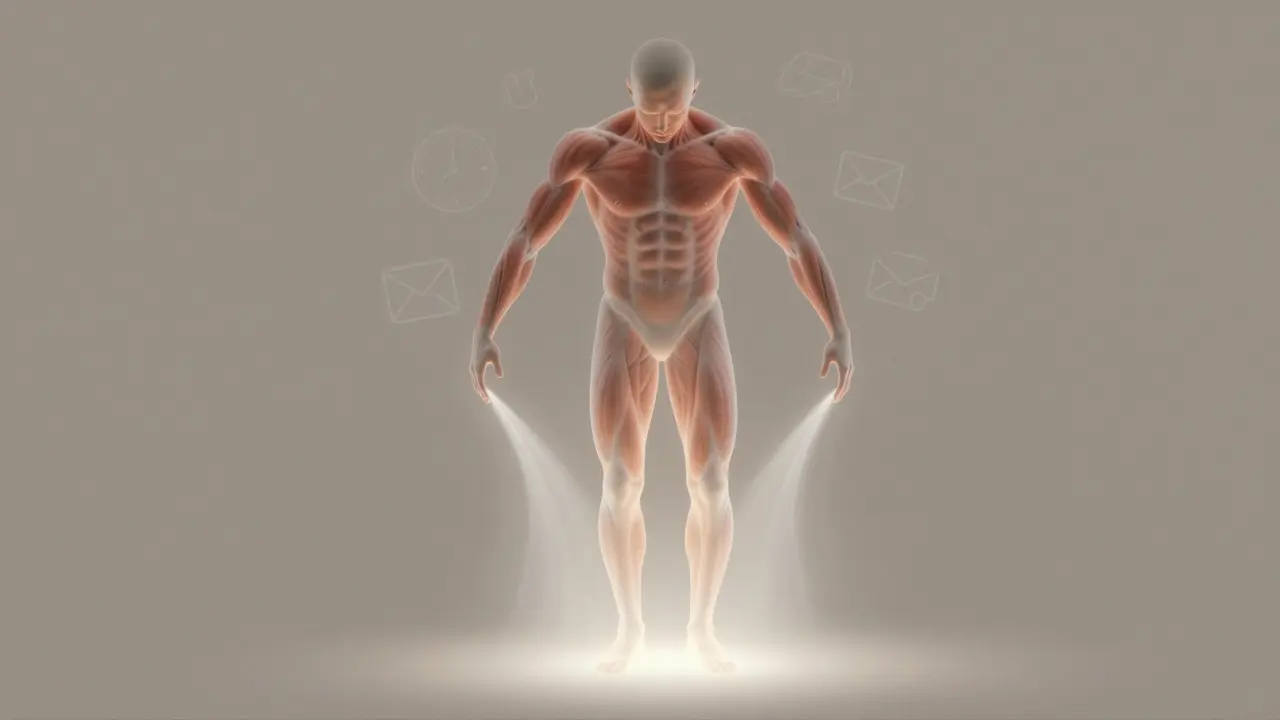
Most of us carry tension like invisible weights. Shoulders up to your ears. Jaw locked. Hips tight. You’ve probably never noticed because it’s been there so long. Progressive muscle relaxation (PMR) helps you find it-and let it go.
Start with your feet. Tighten the muscles as hard as you can for five seconds. Then release. Feel the difference. Move up: calves, thighs, buttocks, abdomen, chest, hands, arms, shoulders, neck, face. Squeeze. Hold. Let go. Each time you release, you’re telling your body: "You don’t have to hold on anymore."
This technique was developed in the 1920s by Dr. Edmund Jacobson, and it’s still one of the most effective tools for anxiety and insomnia. A 2023 meta-analysis in the Journal of Clinical Psychology found that people who practiced PMR five times a week for four weeks reported a 41% drop in perceived stress. You don’t need to do all 16 muscle groups every time. Start with just your shoulders and jaw. Two rounds a day is enough to rewire your stress response over time.
Mindfulness: Not Just a Buzzword
Mindfulness isn’t about emptying your mind. It’s about noticing what’s already there-without judgment. You’re not trying to become zen. You’re just learning to pause before you react.
Try this: Pick one routine activity. Brushing your teeth. Washing dishes. Walking to the mailbox. Do it slowly. Notice the temperature of the water. The smell of the toothpaste. The weight of the brush in your hand. When your mind wanders to your to-do list (and it will), gently bring it back. No scolding. No frustration. Just return.
Research from Harvard Medical School shows that eight weeks of daily mindfulness practice shrinks the amygdala-the brain’s fear center-and thickens the prefrontal cortex, which handles rational thinking. That means less panic, better decisions, and fewer emotional overreactions. You don’t need to sit cross-legged for an hour. Five minutes while waiting for your coffee to brew counts.
Grounding: The 5-4-3-2-1 Trick When Everything Feels Overwhelming
When panic hits, your brain goes into survival mode. Everything feels urgent. Loud. Too much. Grounding pulls you back into your body and the present moment. The 5-4-3-2-1 method is simple, fast, and works even if you’re in a crowded office or on a noisy subway.
- Name five things you can see.
- Four things you can touch.
- Three things you can hear.
- Two things you can smell.
- One thing you can taste.
It sounds silly. But it works. Why? Because it forces your brain to shift from emotional overwhelm to sensory awareness. A 2022 study from the University of California found that 87% of participants using this technique reported reduced anxiety within 90 seconds. Try it next time you feel a panic spike. You’ll be surprised how quickly the world feels stable again.
Visualization: Your Mind’s Escape Room
Imagining a calm place isn’t fantasy-it’s neurology. When you vividly picture a peaceful scene, your brain activates the same regions as if you were really there. That’s why visualization is used by athletes, soldiers, and surgeons to manage stress.
Close your eyes. Picture a place that makes you feel safe and still. Maybe it’s a beach at sunrise. A forest path. A cozy cabin with a fire. Now add details: the sound of waves. The smell of pine. The warmth of sunlight on your skin. Stay there for two minutes. Breathe into it.
Researchers at the University of Wisconsin found that people who practiced guided visualization for 15 minutes a day for six weeks had lower resting heart rates and improved immune markers. You don’t need audio guides. Just your memory and a quiet moment. Do this before bed or during a lunch break. It’s mental travel, and it costs nothing.

Why These Techniques Work Better Than You Think
Most people try relaxation techniques once, feel nothing, and give up. That’s because they expect instant transformation. But these tools aren’t about fixing you in one go. They’re about rewiring your nervous system over time.
Think of it like building muscle. You don’t lift once and get abs. You show up. Consistently. The same goes for relaxation. Doing one technique for five minutes a day, five days a week, changes your baseline stress level. Your body learns: "I don’t need to be on high alert all the time."
And here’s the kicker: you don’t need to do all of them. Find the one that clicks. Maybe deep breathing works best for you. Or maybe grounding saves you during panic attacks. Stick with that one. Master it. Then, if you want, add another. Progress isn’t about doing more-it’s about doing what sticks.
What Doesn’t Work (And Why)
Let’s be real. Some "relaxation" methods are just distractions. Binge-watching Netflix. Scrolling TikTok. Drinking wine until you zone out. These don’t reduce stress-they delay it. And they often make it worse.
Why? Because they don’t engage your nervous system. They numb it. True relaxation techniques don’t distract you from your feelings. They help you sit with them, understand them, and release them. That’s why journaling, breathwork, and body scans work. They create space. Distractions just fill it.
If you’re using screen time to escape, try replacing 10 minutes of scrolling with five minutes of deep breathing. Notice the difference. You might be surprised how much calmer you feel without the noise.
Start Today: Pick One
You don’t need to overhaul your life. Just pick one technique and try it for seven days. Set a reminder. Do it at the same time each day-morning, before bed, or right after work. Track how you feel. Not in grand terms. Just note: "Less jaw tension." "Fell asleep faster." "Didn’t snap at my partner."
Relaxation isn’t a luxury. It’s a survival skill. And like any skill, it gets stronger with practice. You’re not trying to become a monk. You’re just learning how to stop fighting yourself.
How long does it take for relaxation techniques to work?
Some effects, like lowered heart rate or reduced muscle tension, can happen within minutes. But lasting changes-like better sleep, less anxiety, or improved focus-usually show up after consistent practice for 2-4 weeks. Think of it like brushing your teeth: you don’t see results after one time, but daily habits change your oral health over time.
Can I combine relaxation techniques?
Absolutely. Many people pair deep breathing with mindfulness or grounding with visualization. Combining techniques can deepen the effect. For example, breathe slowly while naming five things you see. Or tense muscles during a grounding exercise. There’s no right way-just what feels natural to you.
What if I can’t focus during meditation or breathing?
It’s normal. Your mind will wander. That’s not failure-it’s part of the process. The goal isn’t to stop thinking. It’s to notice when you’ve drifted and gently return. Each time you do that, you’re strengthening your focus muscle. Even if you only stay present for two seconds, that’s progress.
Do I need special equipment or apps?
No. While apps and timers can help, none of these techniques require tools. You can do deep breathing in your car. Grounding at your desk. Visualization in bed. The power is in your body and mind-not your phone.
Are these techniques safe for everyone?
Yes. These are low-risk, non-invasive methods. However, if you have severe anxiety, PTSD, or chronic pain, consult a therapist before starting. Some people may find certain techniques triggering (like body scans), and that’s okay. Adjust or skip what doesn’t feel right. Your comfort matters more than following a routine perfectly.